Salesforce Spring ’26 Release Core Guide: Leap into the ‘Agentic Enterprise’

Not Just an Update, a Transition of the Collaboration Model Between Humans and AI
This Salesforce Spring ’26 Update focuses on realizing the ‘Agentic Enterprise’ which goes beyond simple feature improvement to combine human expertise and AI agents, fundamentally innovating the way enterprises operate.
We analyze 5 core changes of Spring ’26, which will become the new standard for Enterprise AI, in detail from an expert's perspective.
1. Full-scale Brand Reorganization and Expansion: Full Entry into 'Agentforce' Era
The core cloud services we used to know have been reorganized around AI agents and reborn with a new name, Agentforce.
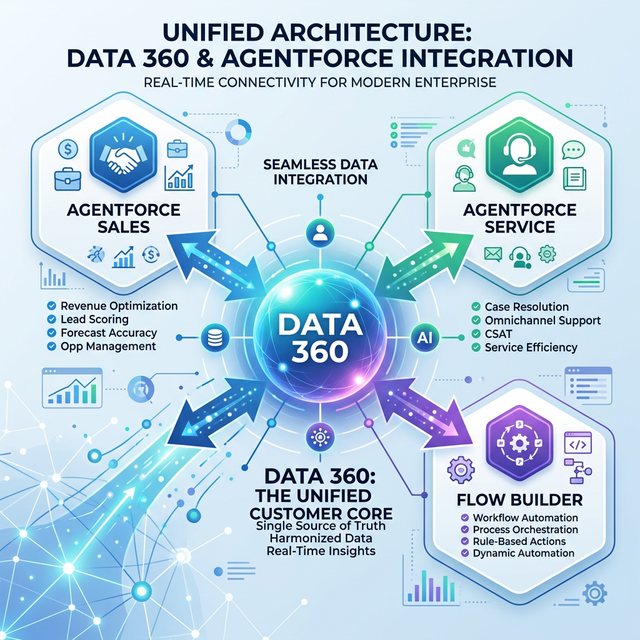
- Name Changes: Sales Cloud changed to Agentforce Sales, and Service Cloud to Agentforce Service. Health Cloud and Communications Cloud were also updated to Agentforce Health and Agentforce Communications, respectively.
- Agentforce Builder General Availability (GA): The new Agentforce Builder, capable of building powerful and predictable AI agents, has been officially released. Now, admins can easily design and debug agents performing complex multi-step workflows by combining natural language prompts with logical expressions (Agent Script). Standard templates for Employee Agents are also provided in addition to existing service agents.
2. Innovation of Administrator Work: Setup with Agentforce (Beta)
The working method for Salesforce administrators (Admin) changes dramatically. Through Setup with Agentforce, an AI assistant, you can process complex configuration tasks quickly and easily in a conversational manner.
- Intelligent Problem Solving: When asked a question like why a certain user lost permission (e.g., "Why can this specific user no longer manage users?"), the agent analyzes Setup Audit Trail to find accurate causes based on changes in permission sets, profiles, roles, etc.
- Mobile App & Page Generation: After analyzing the admin's workflow, AI automatically builds Salesforce mobile apps and homepages customized to specific roles or data through conversation.
- Accelerated Data Modeling: You can create and manage user-defined objects (Custom Objects), fields, and relationships through conversation right on the user interface.
3. Evolution of Data Cloud: Data 360
Data Cloud, which was in charge of integrating enterprise data, has been newly rebranded as Data 360.
- Data 360 Notebook AI (GA): This feature lets you upload scattered internal information, web links, and personal files into one intelligent workspace and ask questions to AI. Through this, you can quickly find solutions for RFP drafting or complex customer support cases, solving siloed implicit knowledge within the organization.
- Ready-to-Use DLO (Data Lake Objects): Standard DLOs and mappings are provided by default to reduce initial setup time for data collection, making collected data immediately available for business.
- Code Extension-based Data Transformation (Beta): If default batch data transformation features don't meet business requirements, users can apply custom data transformation (Transforms) logic using Python code written directly by themselves.
4. Next-Gen Automation Combined with AI: Flow Builder
Agentforce is now embedded into Flow Builder, an automation tool, enabling users to modify and evolve existing flows through natural language without making flows from scratch.
- Flow Modification through Natural Language: Instructing in the Agentforce panel to "add a Decision element verifying if the opportunity is Closed Won" or "delete a Loop element processing inactive accounts" will see flow elements added, modified, or deleted automatically.
- Cost Efficiency: This feature does not consume Generative AI credits and dramatically shortens the time to build complex business logic.
5. Modernization of Security and Permission Systems: External Client Apps
To comply with security best practices, the creation of existing Connected Apps will be disabled by default in all Salesforce orgs.
- Moving forward, you must use External Client Apps providing stronger security and management convenience for new external system linking and integration instead of Connected Apps.
- Existing Connected Apps will operate normally, but tools will be provided to migrate existing SAML and OAuth-based Connected Apps to External Client Apps with just a few clicks.
Outro
The Spring ’26 update shows a paradigm shift where AI agents melt into all layers of the organization from system setup to sales, service, and data analysis, not just adding simple features. Try introducing the Agentic Enterprise environment early to your company, where Agentforce increases work autonomy based on data refined through Data 360.
Check the official release notes below for more detailed technical specifics.
📘 Official Verification of Salesforce Spring ’26 Release Notes
NexusForce provides professional consulting to apply the new Salesforce Spring ’26 features most effectively to your business. Contact an Expert